Obtaining $12M in infrastructure funding for rural Midwestern towns
Context/Problem:
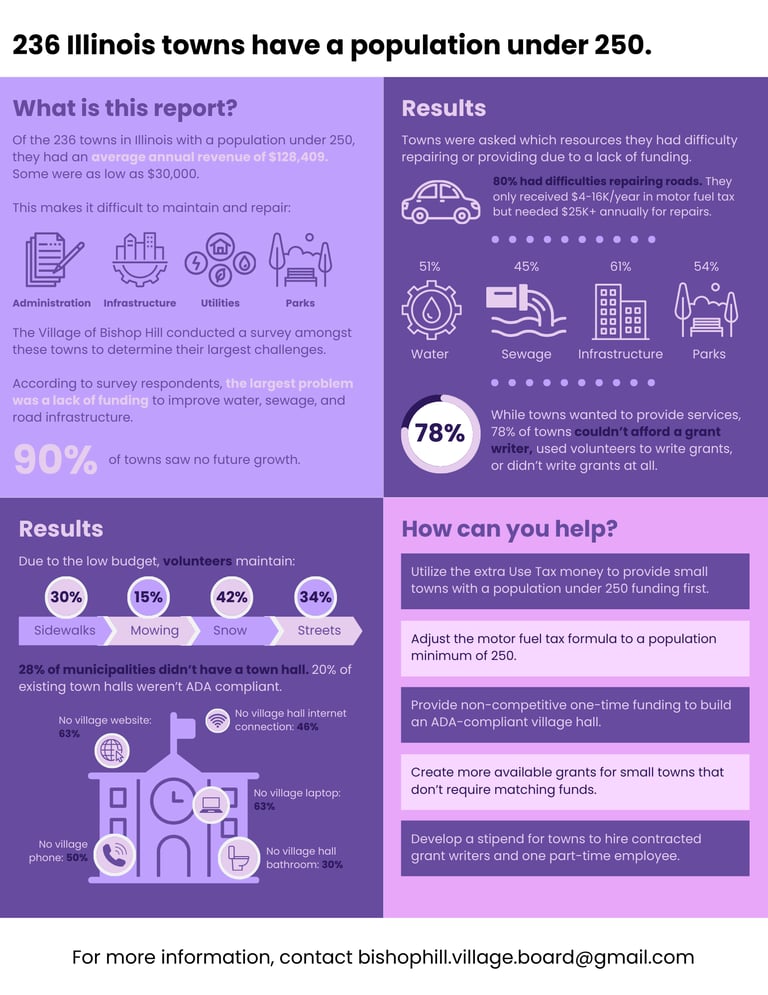
There are 243 small towns in the state of Illinois with a population under 250. Annual municipal budgets are allotted by the State of Illinois based on population count. This means that smaller towns may only receive an annual budget of $20-100K. This prevents necessary infrastructure repairs, such as constructing roads, sidewalks, or fixing water production.
Action/Solution:
I decided to develop policy solutions that could solve this problem. The goal was to ensure that small towns could be financially solvent. I worked on behalf of the Village of Bishop Hill, where I served in both research and lobbying roles.
Research
First, I collected data about the finances of these communities from the Illinois Comptroller’s Office. They provide a database of assigned annual budgets. I isolated the data from the 243 small communities. I utilized the US Census data to obtain appropriate population and demographic information.
From there, I found the contact information of the mayors of these towns through the Illinois Municipal League and the Illinois Commerce Commission. I distributed a multiple-choice survey that asked about the average costs of infrastructure repair, difficulties they faced. The categories included:
Infrastructure Maintenance (roads, bridges, water, sewage, public buildings, parks, cemeteries)
Annual Infrastructure Repair Costs
Contractor Details (reliance on paid contractors or volunteers, costs of contractors)
Municipal Infrastructure Responsibilities
Administrative Operations (whether they had a town hall, internet connection, paid employees, etc.)
Public Services Provided (Law enforcement, fire department, EMT, public education, etc.)
Municipal Employee Compensation
Governance Structure and Board Diversity
Municipal Finance (whether they have a treasurer, payroll, accounting procedure, auditing, budget breakdown)
Utilities Provided (gas, electric, water, sewage)
Familiarity with State-Level Grant Programs (GATA, DUNS, CARS, ICQ, ARPA)
Annual Revenue from External Sources (motor fuel tax, grants, sin tax)
Obstacles in Grant Applications (lack of funds for a grant writer, competitive process, limited eligibility, etc.)
Anticipated Growth (population, businesses, services, etc.)
From there, I emailed and called mayors to ask them to complete the survey.
Then, I joined the data from the Illinois Comptroller, the US Census, and survey data in R, handled missing values, and created factors to make them statistically readable. From there, I performed exploratory data analysis to identify the median budget, distribution, and cost analysis of the annual infrastructure costs by subtracting them from the annual municipal budget.
After that, I used regression plots to show correlations between different criteria, such as the presence of a grant writer/paid staff vs. grant income, population size vs. obstacles in grant applications, etc.
Then I constructed linear regression models to determine the correlation of annual budget with infrastructure decay and the correlation between annual budget and grant knowledge to determine whether the issue was population-based or if familiarity with grants was a significant hurdle.
Determining this data was crucial to outlining the extreme deficit these communities are facing: 90% of communities surveyed saw no future growth.
Lobbying
From there, I was able to review policy solutions and display them to legislators. I proposed five policy solutions:
Adjust the motor fuel tax formula to a population minimum of 250.
Currently, the Illinois motor fuel tax is distributed strictly per capita. If a town has 50 people, they receive a fraction of what a town of 5,000 receives, even though both might have the same mileage of road to plow and salt. This sets a floor where any town is funded as if it had exactly 250. Further research could have been done to find the average project finance costs to establish the true viable floor.
Provide non-competitive one-time funding to build critical infrastructure projects.
Small towns often lose competitive grants to larger cities like Aurora or Rockford that have professional grant departments. Removing the competition ensures the 243 towns aren’t being out-competed by cities with more resources.
Create more available grants for small towns that don’t require matching funds.
A strong hurdle I encountered was that state grants typically require 75/25 or 80/20 cash investments in infrastructure projects. If a town needs to construct a $500K water tower, the state would require $100K in cash. This is often worth multiple years of funding.
Develop a stipend for towns to hire contracted grant writers and part-time employees.
The majority of communities I contacted had no full-time employees, and much of their work was through community volunteers. This included shoveling snow from sidewalks, landscaping, cemetery maintenance, and even repairing playgrounds, ball diamonds, and other community spaces. This allows an administrative stipend to help communities alleviate either the administrative burden of community execution or the “Catch 22” of requiring a grant writer to receive grant funding.
Utilize the extra Use Tax money to provide small towns with a population under 250 funding first.
Use Tax revenue is pooled and distributed by population. This policy would carve out a portion and prioritize a “Small Town Solvency Fund” before the remainder is distributed to larger cities. Large cities usually have a diversified tax base (property, sales, and hotel), while small towns are 100% dependent on state-shared revenue. Use Tax is growing due to e-commerce, which makes it a more stable source of income.
Creating these policy recommendations, I contacted all legislators in the Illinois House of Representatives. I served as the representative of the Village of Bishop Hill at the 2024 Illinois Municipal League Lobby Day and attended virtual or in-person meetings with over a dozen legislators.
I spoke to them about the issues towns were facing, the research conducted, and potential solutions, highlighting the small quantity of investment required in proportion to the larger state budget.
Outcome/Impact:
A collective group effort resulted in a $12M infrastructure investment in one of the small towns.
Several groups were working with the Village of Bishop Hill, Illinois. I completed this project on their behalf to gain greater municipal support from other small towns. The Save Bishop Hill nonprofit worked to contact legislators to draw attention to the failing infrastructure of the town, including sending photos of collapsing buildings and state-owned fences. Senator Travis Wiener also served as a representative from the region who advocated in the legislature.
This funding was allocated by the Illinois Department of Natural Resources and the Capital Development Board. This was announced in April 2025 after over three years of advocacy. In November 2025, an additional $5M was allocated by the Governor’s Office of Management and Budget, driven by legislators I engaged with.
While this was not a long-term improvement in municipal budgets, it did result in a substantial infrastructure improvement underway into 2030 for one of the communities. This still signals a long-term battle required for systemic policy change. However, this provides a proof-of-concept that lobbying and effective data can create substantial change. Receiving a total of $17M for a town with a population of 130 is an extremely high ROI. Bishop Hill can now serve as a case study and pilot program for small-town solvency.