Creating wildlife conservation programs in Namibia through the DOS
Context:
The US Department of State partnered with the nonprofit 10 Billion Strong and the Namibian embassy to host a cross-cultural program exchanging knowledge between 15 US students and 15 Namibian university students. The goal was to develop a project that solved a problem in Namibian society, focused on wildlife conservation.
Problem:
Namibia is home to some of Africa’s most important wildlife populations, yet many local students have limited access to education about conservation policy, environmental governance, and sustainable resource management.
While national conservation programs exist, there is often a gap between policy discussions and classroom education, particularly in rural areas where wildlife conservation directly affects communities and livelihoods.
Students needed accessible educational programming that explained:
How conservation policies are developed
The role of local communities in wildlife protection
How environmental policy connects to economic development and sustainability
Actions:
The goal was to design a curriculum that introduced students to wildlife conservation policy while incorporating perspectives from multiple stakeholders.
To accomplish this, I coordinated an international team of approximately 30 contributors who collaborated on research, curriculum development, and program design. I primarily steered them in a more impactful direction after initial discussions were primarily about planting trees versus developing a repeatable strategy.
To ensure our work was sustainable over time, I guided the group in creating a wildlife conservation and environmental policy curricula for younger schoolchildren.
Core topics included:
Wildlife conservation strategies in Southern Africa
Community-based natural resource management
Human–wildlife conflict and mitigation strategies
The economic value of conservation and ecotourism
Environmental policy frameworks in Namibia
Lessons were designed to balance scientific and policy perspectives with practical examples that were relevant to local communities.
The project required collaboration across multiple groups involved in conservation and education.
Key stakeholders included:
Government officials responsible for conservation policy
Environmental NGOs working in wildlife protection
Local community leaders and educators
By coordinating across these groups, the curriculum incorporated both policy expertise and local knowledge, ensuring that the educational materials were contextually relevant.
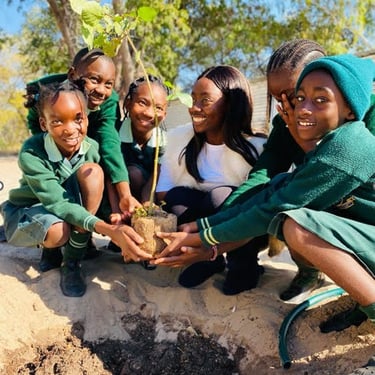
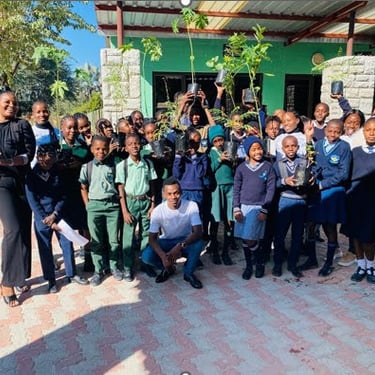
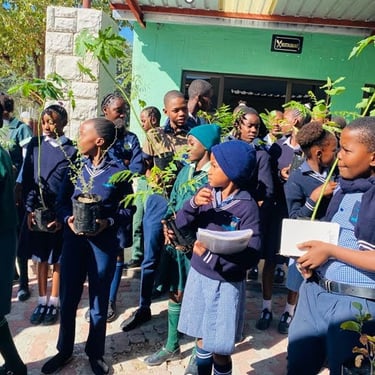
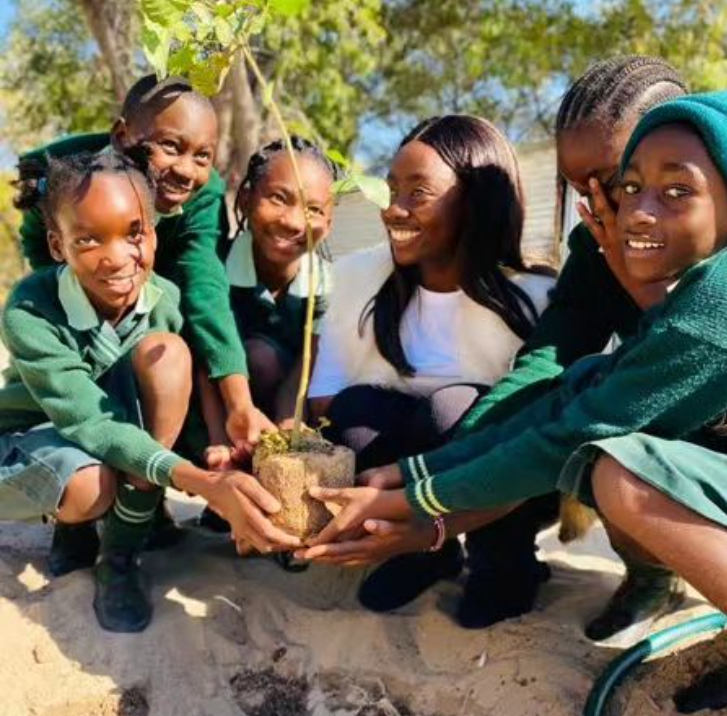
The curriculum was delivered through environmental education programming in northern Namibia. The students on the ground in Namibia used the curricula resources I developed and hosted workshops for 200 students in the Eenhana region. They encouraged discussions about the importance of wildlife conservation and community roles in protecting biodiversity, and they helped younger students plant trees in support of sustainability initiatives.
Results:
Through this program, I led a team of 30 to develop our strategy and approach to the problem, and we helped 200+ children learn more about wildlife conservation.