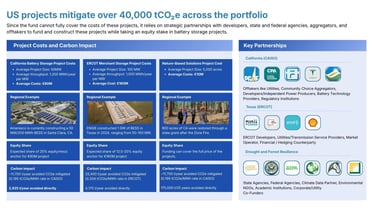
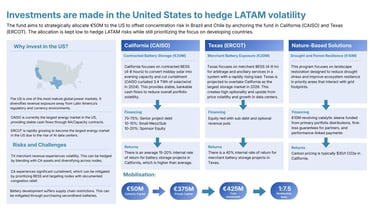
Analyzed the capital flows of funding into California (CAISO) and Texas (ERCOT) utility-scale battery storage projects.
Context:
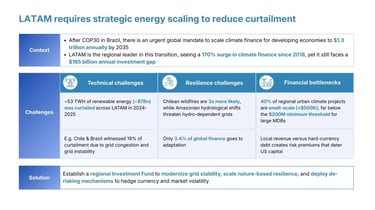
Despite a 170% surge in climate finance in LATAM since 2018, the region faces a $165 billion annual investment gap due to curtailment, grid congestion, wildfires impacting grids, and many projects being small-scale to fall beneath the threshold for larger development bank funding ($200M).
Solution:
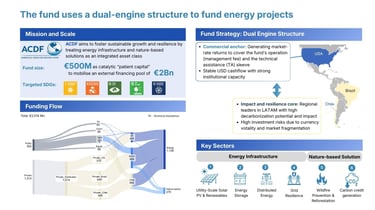
The hypothetical Americas Cross-Derisking Fund is a regional investment vehicle in the United States, Brazil, and Chile designed to bridge the gap in LATAM. The fund focuses on energy infrastructure and nature-based solutions to foster sustainable growth and energy transitions.
It provides $500M in patient capital provided by public sources to leverage $1.514B from private investors. The goal is to act as a dual-engine using the United States as a commercial anchor to utilize mature power markets (CAISO and ERCOT) to generate stable cash flows. This hedges against LATAM’s regulatory and currency volatility.
Focus by Country:
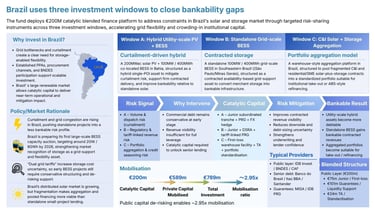
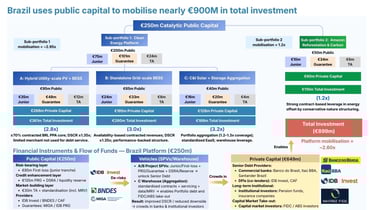
Brazil: $250M is deployed to address solar and storage constraints. It utilizes three investment windows focusing on hybrid utility-scale photovoltaics and BESS, standalone grid-scale BESS, and C&I solar aggregation. It provides junior subordinated tranches, first-loss warehouse facilities, and FX hedges to unlock senior lending.
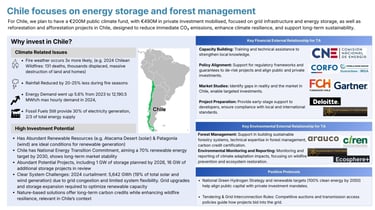
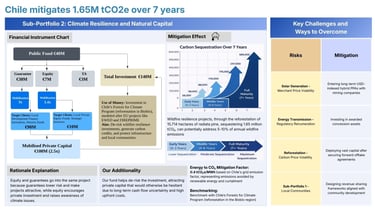
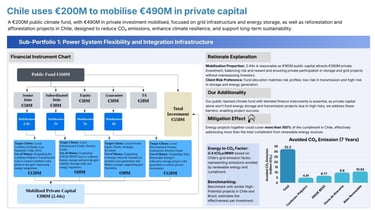
Chile: $200M is deployed to mobilize $490M in private investment for grid infrastructure and nature-based resilience. This targets the reduction of the 5,642 GWh of energy curtailed in the country in 2024. Simultaneously, it focuses on smaller reforestation projects to prevent wildfire risks in the region.
United States: $50M is deployed to focus on battery energy storage systems in California and Texas, as well as reforestation to prevent wildfires. In California (CAISO energy market), the focus is on contracted BESS to convert midday solar into evening capacity, targeting an IRR of 15-20%. In Texas (ERCOT), the focus is on merchant BESS for arbitrage and ancillary services, targeting a projected 40% IRR.
Impact:
The goal of this fund is to expand access to clean energy in LATAM, both for the benefit of US investors in large energy markets like Brazil and for the benefit of deploying energy in the region itself. These projects achieve the goal of creating stable revenue while mitigating over 40,000 tons of carbon emissions annually and mitigating wildfire risk through reforestation.
This reduces the risk of energy projects while protecting local communities from climate disasters. By providing de-risking mechanisms like guarantees and junior capital, the fund enables private participation in projects that would otherwise be considered too high-risk.